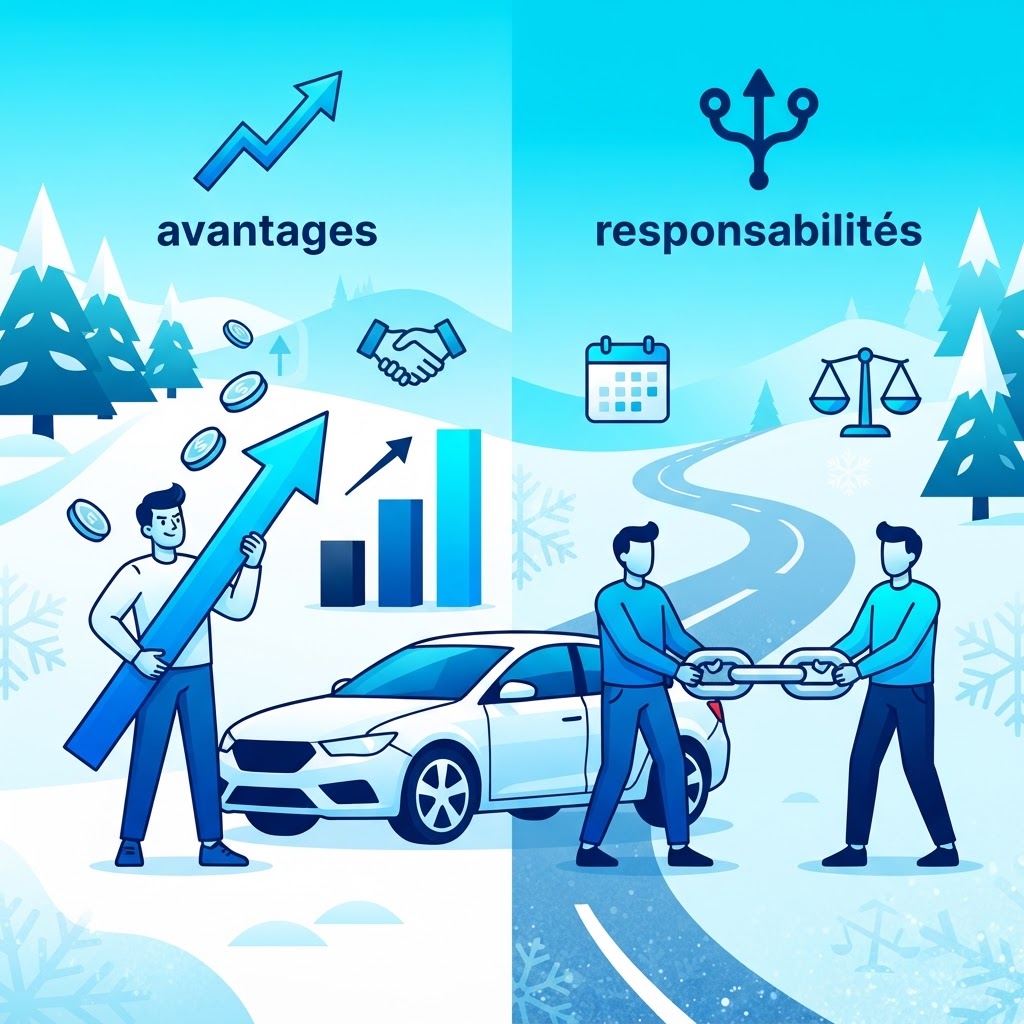
When a co-signer really changes the game
I’ll be honest: when a client has bad credit, a co-signer can be the difference between a flat rejection… and a solid approval with much more manageable conditions.
I see it every week at Prêt Auto Québec. Not just on paper, but in real life. A single mom in Trois-Rivières who needs an SUV before December 1st for winter tires, a worker in Laval who is quietly rebuilding their file after late payments, a couple in Quebec City who thought they had to wait another 18 months to buy. Often, the co-signer becomes the bridge between a difficult credit situation and realistic financing.
But be careful: this is not just a formality. Being a co-signer isn’t just a symbolic “helping hand.” It is a legal commitment to the debt. And that’s something many people misunderstand at the start.
Bad credit auto loans: Why lenders sometimes ask for a co-signer
When a bank or specialized lender looks at an auto loan application, they aren’t just judging the person. They are looking at risk.
In 2026, in Quebec, for a strong file, we still see rates around 6.49% to 8.99% for recent vehicles, depending on the term, the age of the car, and the overall profile. As soon as you enter specialized credit — late payments, collections, high debt-to-income ratio, consumer proposal, discharged or undischarged bankruptcy — you can quickly jump between 11.99% and 19.99%, sometimes higher in very difficult cases.
The co-signer serves to reassure the lender on three points:
- Overall ability to pay;
- The stability of the file;
- The probability that the loan will be repaid in full.
If the primary person has a weakened score but a stable income, simply adding a co-signer with a good history can reduce the perceived risk. And when risk drops, options increase.
I’m not saying the rate automatically becomes low. It’s not magic. But between a rejection, an 18.99% rate, or an approval at 12.49%, the difference over 60 or 72 months is huge.
What a co-signer concretely improves
In my line of work, I always look at the real impact, not just the theory. Here is what can change.
A better rate… sometimes much better
Let’s take a simple example.
A used car at $22,000. With the GST and QST in Quebec (5% + 9.975%), we arrive at about $25,294 before registration fees, protections, or warranties. Let’s add reasonable administrative fees, and we often find ourselves around $25,500 to finance.
Over 72 months:
- at 18.99%, we are talking about roughly $580 to $590 per month;
- at 12.49%, it drops to around $505 to $515;
- at 9.99%, we are near $470 to $480.
This means a difference of more than $100 per month between a very risky file and one strengthened by a good co-signer. Over six years, that’s thousands of dollars.
That’s why I often tell my clients: a good co-signer doesn’t just help “get the file approved.” They can keep you from overpaying for a car.
A more attractive vehicle choice
Another less-discussed advantage: with a co-signer, the lender may accept a newer vehicle with lower mileage or one coming from a larger inventory.
And in Quebec, that is major. Between potholes in the spring, Abitibi winters, the Montreal–Longueuil–Brossard commute in traffic, or tougher regional roads, a reliable car is not a luxury. It’s a matter of total cost.
A cheaper car to buy that is already worn out can cost you more in repairs, tires, brakes, suspension, and surprises. My clients sometimes learn this the hard way.
Faster approvals
When the file is well-assembled, with a co-signer who has their documents ready, we can often get an answer the same day. In many cases, it takes between 30 minutes and 4 hours for a serious pre-qualification. If the file is more complex, 24 to 48 hours is frequent.
At Prêt Auto Québec, my team pushes hard on this. The clearer the documents are from the start — pay stubs, proof of address, license, information on debts — the more we avoid useless back-and-forth.
But the responsibility is 100% real
This is where I see the most misunderstandings.
A co-signer is just as responsible as the primary borrower. Not “almost.” Not “just in case.” Equally responsible.
If the payment isn’t made, the late payment can show up on both people’s credit reports. If the vehicle is repossessed because the loan defaults, the consequences can affect both parties. If the lender pursues the unpaid balance after repossession, the co-signer can also be targeted.
I say this bluntly to families: never co-sign just “to be nice.”
The story of Nathalie and Kevin
I think of Nathalie, a client from the North Shore, who wanted to help her son Kevin get his first car after a period of tougher credit. Kevin was working and earning a decent living, but he had had several late payments on a credit card and an unpaid cell phone bill the previous year.
With Nathalie as a co-signer, we were able to get a much more reasonable approval than solo. Very good move… because Kevin was disciplined. Automatic payments, tight budget, no crazy spending. Eighteen months later, his credit had improved significantly.
The co-signer served their purpose well.
But I have seen the opposite too.
When things go wrong
Another client — let’s call him Marc — had co-signed for his then-partner. They separated a few months later. The vehicle stayed with the ex-partner, but the loan didn’t disappear. Two skipped payments. Result: Marc’s credit suffered even though he didn’t even have the car in his driveway anymore.
It’s tough. And it is avoidable if you ask the right questions beforehand.
Who can be a good co-signer?
It doesn’t need to be a parent. I’ve seen spouses, brothers, sisters, and even a boss in an exceptional case. But a good co-signer, for me, generally checks these boxes:
- Stable credit file;
- Demonstrable and sufficient income;
- Low level of relative debt;
- Clear understanding of their obligations;
- Willingness to assume the risk, not just to help out.
I much prefer a co-signer who earns $55,000 per year with clean credit than someone making $90,000 who is over-indebted. Lenders look at the full picture.
And no, being a homeowner is not automatically enough. Yes, it can help. But it is not a free pass.
Is it the best solution for everyone?
No. And I think many advisors should say that more often.
Sometimes, I recommend not taking a co-signer. Why? Because the client may already qualify on their own for 2nd chance auto credit, even if the rate isn’t perfect, and then rebuild their file for 12 to 24 months before refinancing or changing vehicles.
In some cases, protecting a loved one is more important than gaining 2 or 3 points on a rate.
If the relationship is fragile, if finances are tight, or if the primary person still has unstable payment habits, I am direct: do not drag someone else into this.
A co-signer is not a miracle solution. It is a tool. Used well, it is excellent. Used poorly, it creates two problems instead of one.
How payments are actually calculated
I find it important to explain the numbers clearly because many people look only at the monthly payment without understanding the final cost.
The monthly payment depends mainly on four elements:
1. The amount financed
Vehicle price + taxes + eligible fees - down payment or trade-in value.
2. The interest rate
The higher the risk, the higher the rate.
3. The term
48, 60, 72, sometimes 84 months. The longer the term, the lower the payment, but the more total interest increases.
4. The type of vehicle
An older car or one with very high mileage may be financed at a higher rate or over a shorter term.
Concrete example:
Vehicle at $18,995 With taxes in Quebec, we are around $21,840 With a $1,500 down payment, there is about $20,340 left to finance
Over 60 months:
- at 10.99%: about $442/month
- at 14.99%: about $484/month
- at 19.99%: about $538/month
Before signing, I always encourage my clients to validate the scenarios with our calculator. It avoids surprises and helps choose a realistic term based on rent, groceries, insurance, and the cost of living, which isn’t going down in Quebec, let’s be honest.
The questions I insist on before a loved one co-signs
I say “insist,” because yes, I push my clients to have this conversation.
Who will make the payments, exactly?
It seems obvious. Yet, no. It requires a clear answer. If possible, a pre-authorized payment from the primary borrower’s account.
Who pays for insurance, maintenance, and winter tires?
The auto loan is only one part of the budget. In Quebec, from December 1st to March 15th, winter tires are mandatory. A good set installed is easily $800 to $1,400 depending on the vehicle. Add insurance, SAAQ registration, gas, and oil changes.
If the person is already struggling to make ends meet, the risk of default climbs.
What happens if the relationship changes?
In the case of a spouse, this is an unavoidable question. Who keeps the car? Who refinances? Within what timeframe? I’ve seen it too often: people plan the purchase, but not the worst-case scenario.
Is there an exit strategy?
Very important. I often recommend aiming for 12 to 24 months of perfect payments, then reviewing the file to try to remove the co-signer through refinancing or replacing the loan.
Pro Tip
Don’t choose the biggest vehicle the co-signer allows. Choose the one you can keep without stress.
This is probably the most profitable advice I give.
When a co-signer improves the approval, some buyers immediately go up a range: newer SUV, better-equipped version, higher payment. Bad idea, in many cases.
I prefer a reliable vehicle with a clean history, a manageable payment, and wiggle room for winter, repairs, and daily life. A credit file is restored with consistency, not with a limit payment that you hope to maintain.
If you are thinking about it, start by looking at our inventory with a monthly budget in mind, not just a listed price.
What I recommend to co-signers themselves
If you are thinking about helping a loved one, be a bit of a “bore.” It’s healthy.
Ask to see:
- their income;
- their real budget;
- their other debts;
- the reason for their bad credit;
- their plan to improve the situation.
And above all, ask for proof that the payments are set up automatically. I also like to suggest that the co-signer ask for a verbal monthly check-in at the start. Not to control. To avoid a small problem becoming a big one.
I add a point often forgotten: co-signing can affect your own borrowing capacity. Even if everything goes well, this debt can be taken into account if you want to get a mortgage, refinance, or buy another vehicle.
My honest opinion on co-signing in specialized credit
I am for it… when it is done intelligently.
In the world of specialized credit, I have seen co-signatures save files, lower rates, allow someone to return to work properly, drive their kids to school, and get a fresh start after a rough financial period. I have also seen families complicate their lives for a car that was too expensive, purchased too quickly.
My opinion is simple: the co-signer must serve to build, not to camouflage a problem.
If your budget is too tight, if your job is unstable, or if your recent history still shows delays, it is sometimes better to review the vehicle, the term, the down payment, or the credit strategy before adding a loved one to the contract. And if your situation is heavier — multiple rejections, major credit bureau issues, very damaged file — we can also look at Quebec auto financing solutions that are more adapted or, in extreme cases, other specialized avenues.
At Prêt Auto Québec, that is exactly how my team works. We don’t push a file just to “place” a car. We look to see if the structure really holds up.
If you have bad credit and want to know if a co-signer would really help your approval — or if you would be better off financing alone — submit an application. We will look at your situation properly, with concrete numbers and an honest recommendation.