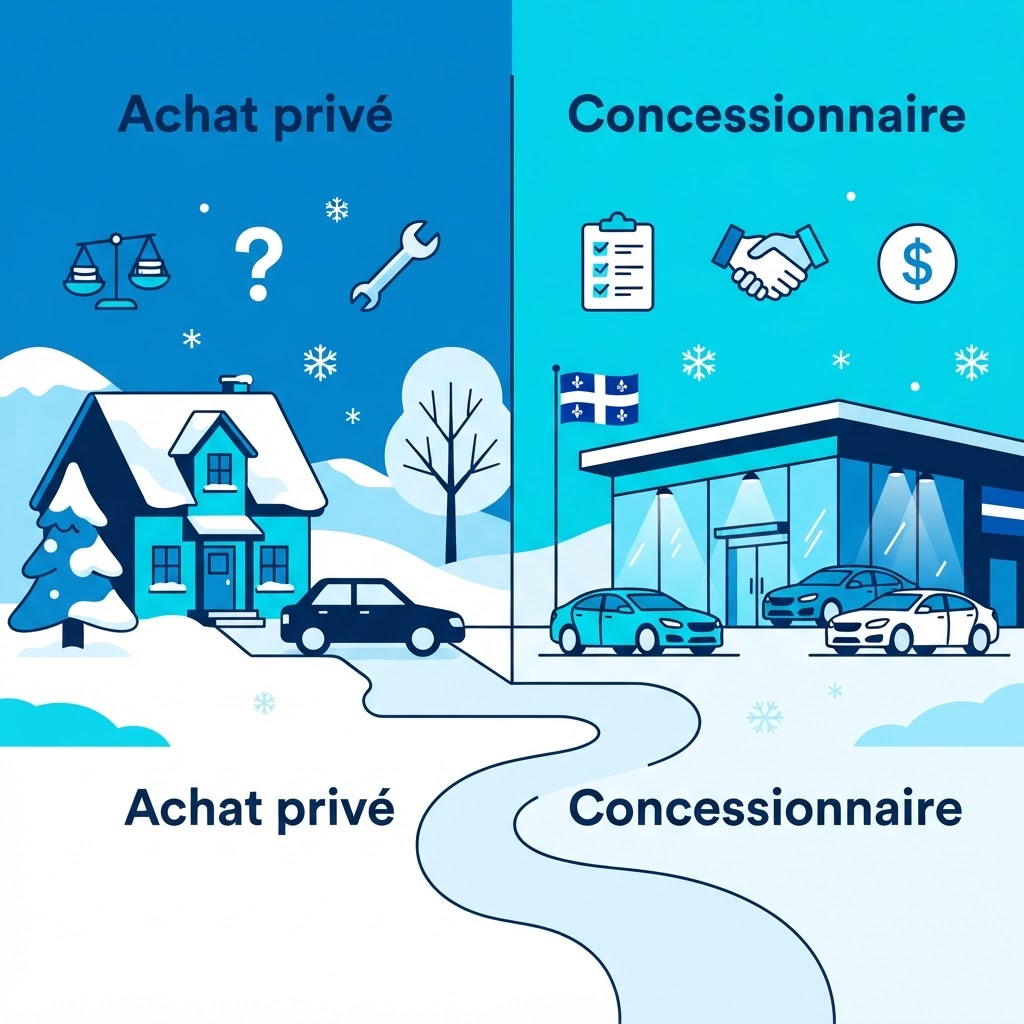
Let’s be honest: Private or dealership, the "best choice" depends mainly on your risk tolerance. After more than 12 years helping buyers across Quebec at Prêt Auto Québec, I’ve seen both scenarios. The customer who finds a hidden gem on Marketplace in Trois-Rivières, and the one who thinks they are getting a deal, only to end up with a car that burns oil, has questionable mileage, or financing that is impossible to get approved properly. My take? For most people, especially in 2026 with the rising cost of living—rent, groceries, insurance, tires, registration—the dealership remains the safer option. But not always the cheapest. A private purchase can save you a few thousand dollars when buying a used car in Quebec… provided you are extremely disciplined. The problem is that many buyers look at the sticker price, but not the total real cost. Between the QST, inspection, necessary repairs before winter, compliant tires (mandatory from December 1st to March 15th), and sometimes higher interest rates if financing is complicated, a “good deal” can change quickly. ## What really changes between a private seller and a dealership When I explain the difference to my clients, I don’t just talk about price. I talk about protection, financing, transparency, and legal recourse. ### Private purchase: The price may be lower, but the risk is all yours In Quebec, a private seller generally offers no legal warranty comparable to that of a merchant governed by the OPC. Simply put: if you buy a car from an individual in Longueuil or Saguenay and the transmission fails two weeks later, your options for recourse are much more limited. Yes, the price is often attractive. Right now, in the Quebec used car market, I frequently see price gaps of $1,500 to $4,000 between a private vehicle and a similar model at a dealership. On a 2018 Honda CR-V or a 2019 Corolla, that is not at all rare. But I will tell you something I have learned over the years: a lower price often attracts buyers who have the least amount of financial margin for error. ### Dealership: You pay a bit more, but you are buying a structure At a dealership, you sometimes pay more, yes. However, you are also buying: - A more structured mechanical check; - A vehicle history that is easier to trace; - The possibility of an extended warranty; - Clearer recourse if the vehicle was misrepresented; - And above all, simpler financing. For many of my clients, this is where the decision is made. When someone has an imperfect credit score, variable income, or little down payment, going through a dealership provides access to more financement auto Québec solutions than a private purchase. ## Money: Where the decision is won or lost I see it every day. Someone calls me and says, “I want to buy from an individual, it’s cheaper.” Perfect. Then we look at the financing, taxes, inspection, preventive repairs, and the actual monthly payment. Then, we come back to reality. ### Interest rates: Private vs. Dealership In Quebec in 2026, for a used vehicle, we often see something like this: #### Buyer with good credit - At a dealership: approx. 6.49% to 8.99% - Financed private purchase: often 8.99% to 12.99% #### Average or challenged credit - At a specialized dealership: approx. 9.99% to 16.99% - Financed private purchase: sometimes difficult, otherwise often 12.99% to 19.99% #### Difficult credit - Financing a private purchase often becomes nearly impossible - A specialized dealership usually remains the most realistic path I am simplifying, of course, because the rate depends on job stability, debt ratio, down payment, vehicle year, and mileage. But the logic remains the same: lenders are less keen on financing private sales because they have less control over the vehicle's quality and the documentation. ### Practical example of a monthly payment Let’s take a used vehicle at $18,000. If you buy from an individual, you must also account for the QST payable to the SAAQ at the time of transfer. If the taxable value is $18,000, the 9.975% QST represents approximately $1,796. Your cost before financing rises to nearly $19,796, not including the inspection. Over 60 months: - at 8.99%: approx. $411/month - at 12.99%: approx. $450/month - at 16.99%: approx. $492/month A 4% to 8% rate difference might seem abstract. In practice, it is $40, $80, sometimes $100 more per month. For a family in Lévis or Laval already juggling groceries and heating bills, that adds up significantly. This is why I always encourage my clients to do the math before falling in love with a vehicle. Our calculator exists for exactly that purpose. ## The tax, the SAAQ, and the details many forget Buying a vehicle in Quebec comes with specifics that many sites explain poorly. ### If you buy from an individual You will handle the transfer at the SAAQ. The QST is generally payable at the time of registration, based on the sale price or the recognized estimated value, according to applicable rules. This still surprises a lot of people. I had a client, Martin, from the South Shore, who had negotiated an SUV for $14,500 privately. He was very happy… until he realized he had to come up with almost $1,450 in QST immediately, on top of buying decent winter tires because it was November. His “deal” suddenly required nearly $3,000 more in cash flow. #### Also remember: - registration fees; - insurance, which is often more expensive for certain models; - inspection certificate if required; - immediate repairs; - winter tires if buying in the fall. Between December 1st and March 15th, your vehicle must be equipped with winter tires that comply with Quebec law. It sounds trivial, but replacing four tires and having them installed can easily cost between $800 and $1,600 depending on size and quality. ### If you buy at a dealership The tax is integrated into the transaction. Financing often includes everything, or nearly everything. It is less brutal on your cash flow. You see the big picture much faster. I am not saying it is always cheaper. I am saying it is often more predictable. And in auto financing, predictability is worth a lot. ## The real danger of private sales: Incomplete history I’ll be direct. The biggest risk of a private purchase isn't just a dishonest seller. It’s an overly trusting buyer. A vehicle can have: - poorly repaired previous accidents; - an inconsistent odometer; - irregular maintenance; - advanced rust issues; - heavy past usage in delivery or ride-sharing; - or even a lien still attached if checks aren't done properly. In Quebec, with our roads, salt, potholes, and huge temperature swings, a tired undercarriage can turn a $2,000 saving into a $4,000 repair bill. ### The story that left a mark I am thinking of Sarah, a client from Quebec City. She found a small private SUV, about $2,800 cheaper than at a dealership. On paper, it was tempting. She called me before signing—thankfully. We insisted on a full pre-purchase inspection. Result: worn brakes, front suspension needing work, early signs of structural corrosion. Estimated cost? A little over $3,200. She called me back later laughing nervously: “In the end, I just saved $3,200 by not buying it.” That is exactly it. ## When the dealership is clearly the best choice I’ll take a stand without beating around the bush. If you are in one of these situations, I almost always recommend the dealership: ### You have difficult credit If your score has suffered, if you have had late payments, a consumer proposal, or a bankruptcy, a private purchase complicates things. Financing becomes more limited, and some lenders simply refuse this type of transaction. In those cases, it is better to look at 2nd chance credit auto options with a team that knows the Quebec file system, the right lenders, and financeable vehicles. ### You don’t have much liquidity If you only have enough for a modest down payment, a private purchase can quickly trap you with the QST, inspection, and initial repairs. ### You need quick approval With us, some requests are processed in a few hours, and many files get a response the same day, sometimes 24 to 48 hours depending on complexity. Privately, everything is more artisanal. The seller has to cooperate, the documents must be clear, and the lender has to accept the vehicle. ### You need a vehicle for work without bad surprises For someone who drives a lot between Drummondville, Montreal, and Sherbrooke, a major breakdown isn't just unpleasant. It is a loss of income. ## When a private purchase can be an excellent idea I am not anti-private sale. Not at all. I even recommend it in certain cases. It is often relevant if: - you are paying cash; - you know vehicles well; - you have a trusted mechanic; - you are buying from a serious person with a complete maintenance history; - you have room in your budget to absorb a repair. In this context, yes, there are real bargains. Especially on reliable Japanese models, 8 to 12 years old, well-maintained, with reasonable mileage and a clear record. But I repeat: without an independent inspection, I wouldn’t do it. Ever. ## How I quickly calculate if the asking price is worth it When a client sends me an ad, I look at four things above all else. ### 1. Total acquisition cost Asking price + QST + registration + inspection + priority repairs + tires if needed. ### 2. Financing cost A cheaper private vehicle can end up costing more if the rate is 4% or 5% higher. ### 3. Useful life Paying $15,000 for a vehicle that will require $5,000 in maintenance over 18 months is not a saving. ### 4. Resale value Some cars resell very well in Quebec. Others do not. I often prefer to advise a clean Civic, Corolla, CR-V, RAV4, or Mazda3 rather than a more “luxurious” model with unpredictable maintenance. #### A quick rule of thumb If the private sale saves you less than $2,000 compared to a comparable vehicle at a dealership, I often find the risk isn't worth it. Especially if the vehicle has more than 120,000 km. ## A word from our expert Here is my most practical advice, the one I give every week: before even going to see the vehicle, ask for three things in writing from the seller—the VIN, maintenance invoices from the last 24 months, and a clear photo of the odometer. With that, you can already eliminate a lot of wasted time. And if the seller refuses a pre-purchase inspection at a garage of your choice? Move on to the next one. Immediately. A good vehicle isn't afraid of being inspected. At Prêt Auto Québec, my team and I prefer to lose a sale than to see a client end up with a mechanical problem or a payment they cannot sustain. That is also why we make our inventory available and guide people step-by-step before signing. ## My verdict, plain and simple If you are disciplined, patient, and well-advised, a private purchase can save you money. But for the majority of people—especially those who are financing, have a tight budget, or want to avoid bad surprises—the dealership offers a much safer framework. It isn't a glamorous answer. It is simply what I observe in the field, year after year, with my clients in Montreal, Gatineau, Quebec City, Terrebonne, or elsewhere in the province. If you are hesitant between a private ad and a dealership option, send us your scenario. My team at Prêt Auto Québec can compare the real cost, validate the financing options, and tell you frankly if it makes sense. You can also submit a request and we will look at it with you, pressure-free.
Find your ideal vehicle
Browse our vehicle inventory and use our free loan calculator.